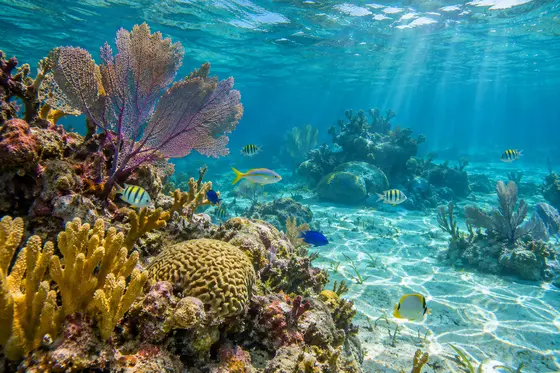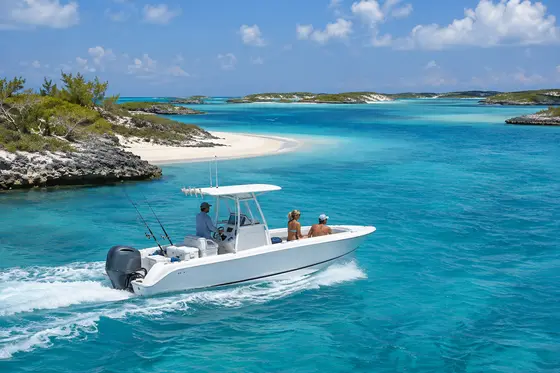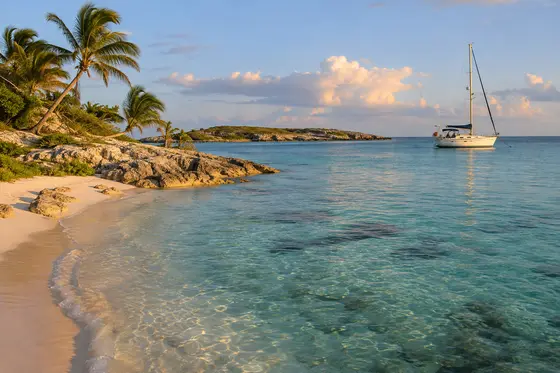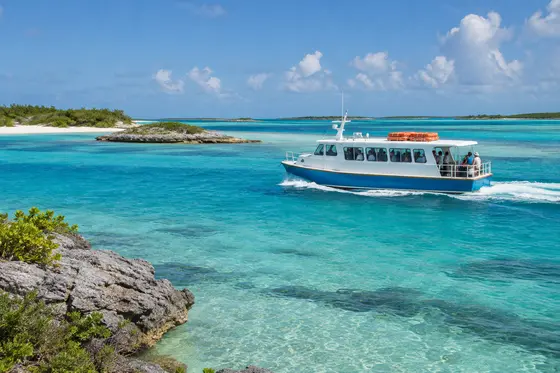
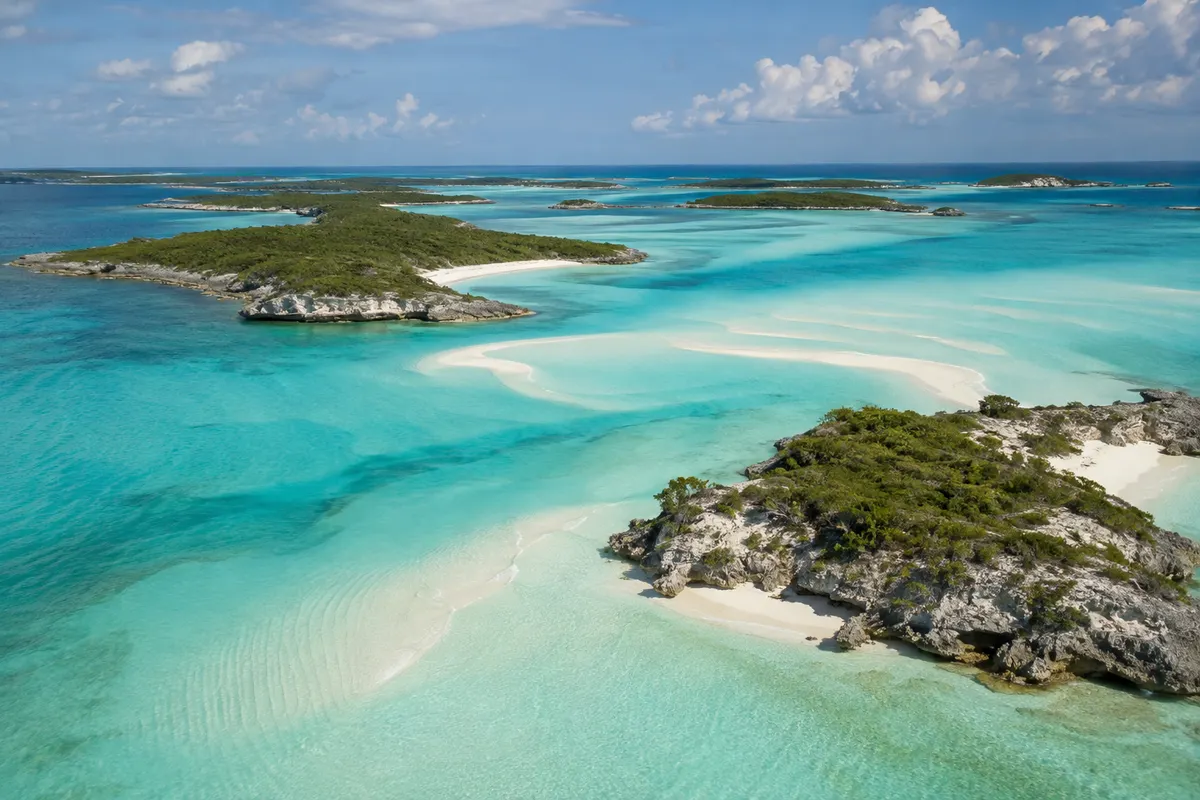
The Exumas form a long chain of islands and cays, not a single compact beach resort. At low tide, pale sandbars appear between the cays. A few hours later they may be covered again. The changing combination of sand, seagrass and deep channels creates the extraordinary blue patterns seen from aircraft and small boats.
Starting on Great Exuma
George Town, on Great Exuma, serves as a practical base for a longer stay. Elizabeth Harbour is dotted with anchored boats, and Stocking Island lies across the water. Beaches along Great Exuma are spread out, so ask about access, road conditions and transport. A car can be useful if you want to spend several days exploring independently.
Exploring farther up the chain
Staniel Cay is farther north and is known as a base for trips to the surrounding cays. Thunderball Grotto is one of the well-known attractions, but it is best visited with a knowledgeable operator who can assess tides, currents and the ability of the group. Swimming pigs attract considerable attention at Big Major Cay. If such an outing appeals, choose an operator that observes responsible wildlife practices; do not chase or crowd animals for a photograph.
Protected waters
Exuma Cays Land and Sea Park encompasses islands, reefs and shallow marine habitats. The Bahamas National Trust manages the park and establishes rules for visitors. Take care not to anchor on coral or seagrass, collect wildlife or bring animals ashore where this is prohibited. Check landing and mooring arrangements before arriving by private boat.
Allow time for bad weather
A tour that covers a large part of the chain can be a long day, and wind may require the operator to alter the route. Instead of insisting on every attraction, discuss the conditions and book the outing early in your holiday so there is an alternative day if needed. The Exuma experience is as much about the light on quiet water as it is about specific sites. The official islands guide provides an overview of destinations and airports.
Seeing the sandbars and smaller cays
Many of the sandbars appear only at particular stages of the tide. When you are choosing a boat trip, ask whether the itinerary is fixed or adapted to the water level and weather. A responsible local captain will change the route if conditions call for it. Sandbars can have fast-moving water at their edges, and there may be no shade after you leave the boat. Take advice about where to walk or swim, and remember that a sandbar is not a permanent island. Choose one or two sights and allow the extra time needed to enjoy them.
The road south to Little Exuma
Great Exuma and Little Exuma are linked by a bridge, so a visit farther south offers the chance to stay on land for the day rather than arrange a boat every morning. This works well as a contrast to the long excursions to the northern cays. The road passes through settlements and areas of low bush, sometimes with views of the water. Rather than trying to stop everywhere, ask your accommodation for a couple of suggested beach access points in the direction you want to travel and find out where you can get a meal.
The Tropic of Cancer Beach, also called Pelican Beach, takes its name from the latitude associated with its location on Little Exuma. The beach itself curves around clear water, with dunes in places separating the shore from the land behind it. It can feel secluded compared with the beaches of a large resort. That means you should be properly supplied for an independent visit. Carry water and anything else you need, check access and weather before leaving, and avoid driving or walking on fragile dunes. Some areas of the island have limited services and you should plan where to stop for provisions on your return.
A morning on Stocking Island
The crossing from George Town to Stocking Island offers a way to experience the harbour without committing to a full-day excursion among the remote northern cays. Ask the transport operator where to board, which landing point is best for the area you want to see and whether return trips must be reserved. Accommodation and popular eating places are located on or near sections of the harbour coast, but the island is also interesting from the point of view of its geology and vegetation. On the seaward side the character of the shore changes again. A quiet sheltered beach on one coast need not mean that conditions are equally inviting on the opposite side.
If you arrange to explore on foot, find out which paths are open and whether there are privately owned properties along the route. Wear shoes rather than walking over exposed rock in flip-flops. In the heat a short uphill walk can be more demanding than a longer walk on the sand, so carry drinking water and take your time. A morning spent here, followed by lunch in the harbour, leaves the afternoon free for whatever you discover back on Great Exuma.
Moriah Harbour Cay and its diverse habitats
The coast between the southern part of Great Exuma and Little Exuma includes the protected waters of Moriah Harbour Cay National Park. Sandbanks, mangrove environments, dunes and seagrass beds are part of what makes this area so interesting. Much of the life in shallow water is small: juvenile fish, crabs and other organisms have shelter and feeding areas among the vegetation. Looking closely with a guide provides a richer understanding of the place than simply visiting a string of named attractions.
Regulations are not necessarily the same throughout the park. The Bahamas National Trust provides a map of Moriah Harbour Cay National Park identifying different management zones. Discuss planned activities with the Trust or a registered local guide before your visit. In particular, do not assume that every beach can be approached by motorboat or that incidental fishing is allowed wherever you can paddle. Many visitors come chiefly for a gentle guided outing or time spent observing birds and other wildlife. Stay away from nesting birds, avoid landing where vegetation might be damaged and do not take pieces of the habitat for souvenirs. The quiet places are often precisely those that need the most care.
Choosing a shorter or longer cay excursion
When booking an Exuma boat tour, compare the route and departure point rather than relying solely on the number of sites listed. A trip advertised from the Exumas could mean a departure from Great Exuma, another cay or a different meeting point altogether. For several hours on a relatively small boat, comfortable seats and sufficient shade can matter as much as the itinerary. Discuss whether the group will need to board from steps, a jetty or directly from a beach and whether you can manage this comfortably. Find out what life jackets are available, and choose an established operator with a suitably equipped vessel.
If you want to snorkel, ask about the likely conditions at each proposed site and whether assistance will be provided. A visit to a cave entrance can be inappropriate for weak swimmers or during unfavourable tides. A competent captain will be willing to adapt the route when wind or current would otherwise make a landing difficult. Families with younger children might choose a short trip in more sheltered water. To experience more distant northern cays, it may be preferable to stay close to them rather than repeat a long crossing from your room on Great Exuma.
Planning around boats and provisions
Some visitors dedicate an entire holiday to boating through the Exumas. The chain's geography is spectacular but there are important practical differences between visiting a cay with a developed harbour and reaching a remote island. Check arrangements for fuel, water, weather reports and communications before leaving. For independent boating in the Exuma Cays Land and Sea Park, consult the Bahamas National Trust's park information for details of boundaries, visiting rules, mooring and anchorage arrangements. The park's restrictions on collecting marine life are an essential part of its conservation purpose.
Land-based travellers can adopt a little of this approach to preparations too. If the major boat outing is early in the holiday, there is room to move it to another date if the weather demands it. Spend the rest of the time enjoying the land and people around your accommodation. There is no need to treat the northern cays as a list of achievements; an afternoon watching a changing sandbank or a small fish in the shallows can be one of the most satisfying parts of an Exuma visit.