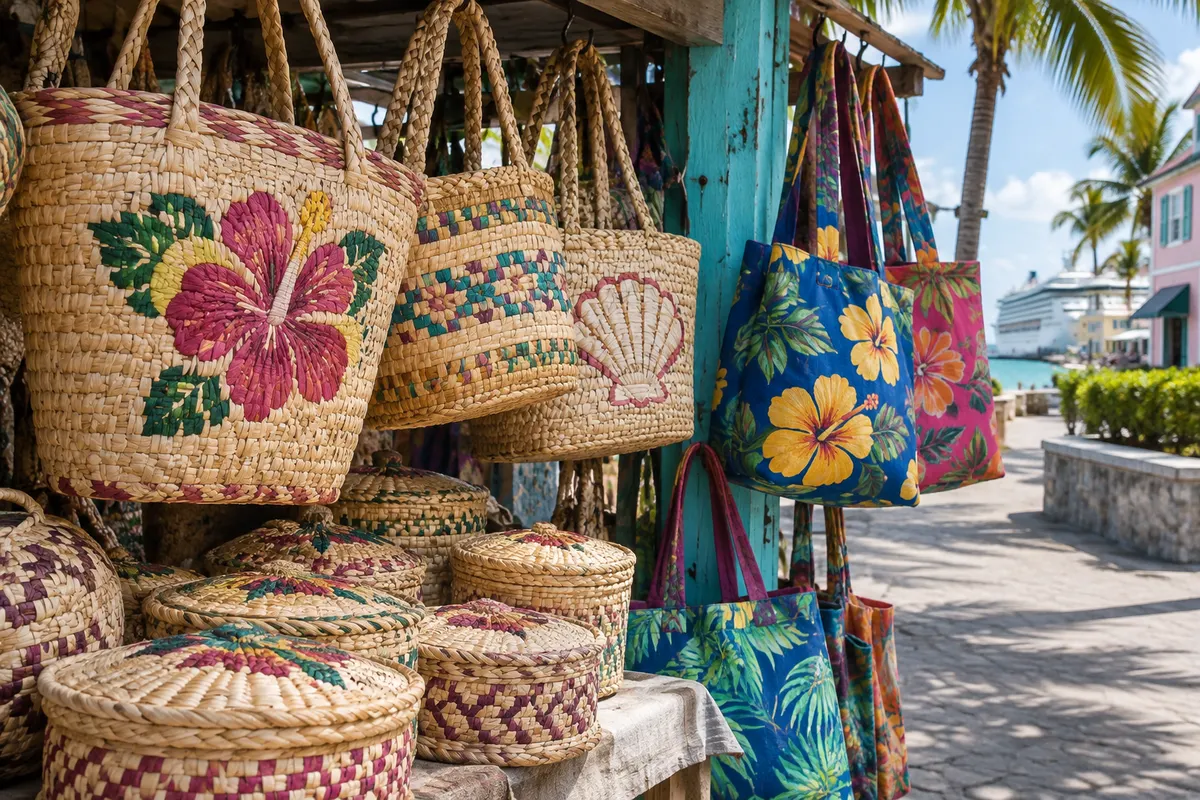
The straw market in Nassau is a familiar stop for many travellers. Among its bright displays are bags, hats and baskets of very different designs and origins. For someone interested in the islands' crafts, it is worth looking beyond the first row of souvenirs and asking how an item was made.
An everyday craft
Weaving plant fibres has a long history in the Bahamas. Palm leaves can be prepared and plaited into strips, which are then stitched or joined into useful objects. Traditional baskets, hats, mats and bags reflect the needs of households and people working outdoors. Designs vary by island and maker. The care with which edges, handles and seams are finished is often a better indication of the quality of work than a decorative label.
The colours and materials sold in a market have changed over the years. Some items incorporate brightly coloured fabrics and manufactured decorations, while others use the natural tones of the straw. Imported souvenirs may be displayed alongside locally made work, so ask where a piece comes from if that matters to you.
Shopping in Nassau
The market is close to the busy downtown waterfront. It is possible to browse without buying on the first visit. Look at the inside of a bag, check the joins and ask whether the maker can explain its construction. Prices naturally vary by size and workmanship. Agree on the price politely, and respect a vendor's decision not to negotiate. If you are taking an item home, check the agricultural rules of your destination for plant-based materials.
Beyond the capital
Small shops and craft fairs on the Family Islands sometimes offer opportunities to meet local makers. Ask your host about opening hours or community events. A well-made basket that you use at home for years is a more interesting keepsake than a sack of things chosen in a hurry. It carries something of the island's practical craft traditions, whether you use it at the beach or in your kitchen.
Other island-made souvenirs
Alongside woven pieces, you may find locally made textiles, small paintings, ceramics or decorative objects. Look for makers who describe where the piece was made and what materials were used. Avoid buying items made from protected wildlife or coral, and check regulations before taking any plant or animal product home. A small artwork or locally printed cloth is often easier to pack than a large basket. If you want to support a particular craft, the conversation with the seller can be as useful as reading a souvenir label.
At the market before choosing a bag
Nassau's straw market sits within an area that has long been concerned with the movement of travellers and goods. Bay Street is busy with the usual shops found around a port and with people walking between downtown landmarks. The official tourism listing for the straw market identifies straw vending as a particularly old occupation in the country, with markets in the capital and elsewhere in the islands. The present shopping experience consequently sits at the intersection of an older industry and a modern tourist trade.
Allow a little time to walk around before deciding to buy anything. Look for the stalls where the products are noticeably different from one another rather than making a choice based on the first bright display. One vendor may specialise in hats or small bags, while another has large baskets and decorative articles. Do not confuse a quiet vendor with an uninterested one. A greeting and a simple question about a piece may start a more useful conversation than announcing that you want the cheapest souvenir available.
The market can be busy when ships are in port. Stay aware of your belongings as in any crowded shopping district, and avoid blocking the narrow spaces between stalls. If you want to handle a particularly elaborate or fragile piece, ask first. A market is somebody's place of work: for a maker who has spent time on the surface of a bag, a careless visitor can do damage in a few seconds.
Fibre, plait and shape
There is no single material sold under the word straw. Palm fibres differ in their appearance, stiffness and the ease with which they can be folded, while other plant fibres may contribute a different texture. Preparation matters. Leaves must be processed and dried appropriately if the resulting material is to be worked without breaking. The plaited strands that make up many pieces can be relatively narrow or quite broad. A small change in the width and pattern alters both the final surface and the amount of work needed to form it.
Look where the body of a basket meets the base or where a handle is fastened. These junctions take much of the load when the piece is in use. The structure need not appear perfectly regular to be strong, but it should have deliberate, consistent construction. If the bag has a lining, check how it is attached at the top and whether the seams are neat. It is interesting to compare an object intended for the daily market with a decorative clutch. Their purposes influence the weight of the material, the shape of the opening and the degree of reinforcement around the edges.
Red Bays and the silver thatch tradition
South of the Florida coast, on the northwestern side of Andros, the Red Bays community has a distinctive history linked to Black Seminole families who escaped the United States. Basket makers there use local silver thatch palm material, often referred to as top. The material is prepared and used to produce a characteristic style of carefully sewn basket. The official Bahamas tourism account of the Red Bays basket craft describes the relationship between the community's history and the craft that has been maintained by successive generations. Red Bays baskets have their own heritage, which cannot be judged adequately by comparing them with mass-produced straw souvenirs.
It is revealing to look at the way a basket holds its form. Some traditional designs have close, curving lines that develop gradually from the base upwards. Rather than a flat plait sewn into a simple rectangular bag, the material may be manipulated to give the whole object its rounded contours. The purpose of the basket, whether for carrying, storing or display, governs the details of the design. If you have the opportunity to speak with a maker, ask which parts of the process require the greatest skill. You may find that the work begins long before the final object can be recognised.
Crafts moving between islands
The material from which an object is made need not have come from the island where it was assembled or sold. Some contemporary bags feature silver-top palm plaits from Long Island combined with Bahamian printed fabrics or linings associated with Andros. Sellers may be able to describe these connections to the maker. They provide an interesting example of how island skills can survive within new designs rather than being confined to exact historical forms.
On different islands you may also encounter work in sisal and coconut fibre. In South Andros, for example, the fibres from coconut leaf sheaths have been used to make bags and accessories through the local handicraft association. The finished surface can feel quite different from a plait made with slender palm leaf material. A modern bag using several materials is not necessarily less authentic than a traditional basket. What matters in an informed purchase is understanding the origin of the work, the people who contributed to it and the quality of the finished piece.
Choosing something that will survive the journey home
Think first about where the object will be used. A brimmed hat with a beautiful shape can be awkward to pack and difficult to replace if it is crushed. A sturdy shallow tray may be far more useful at home than an enormous basket. For a beach bag, consider the handles, opening and lining, and whether a wet towel can be carried without damaging the construction. A carefully chosen smaller object is usually a better purchase than an impressive piece that spends its life in a cupboard.
Natural fibres are best protected from heavy dampness and rough handling. Ask the maker how to care for the piece rather than applying oils or cleaning mixtures immediately. Pack it so the joins and edges are not bent under other luggage. If you intend to take several handmade items in a suitcase, check the destination's import rules, particularly where seeds, untreated plant materials or animal products are involved. The provenance of a locally woven piece is worth keeping on a small note alongside it. Years later, someone seeing it in a kitchen or on a shelf may ask where it was made, and you will have a more interesting answer than simply naming an island.