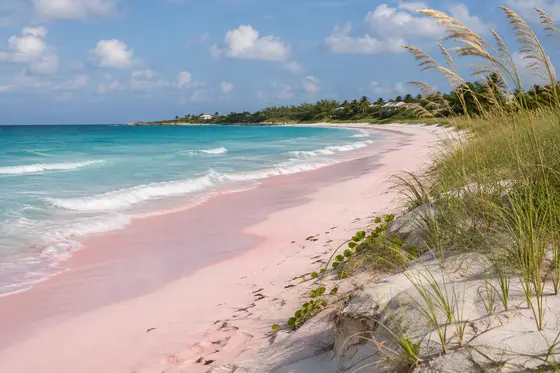
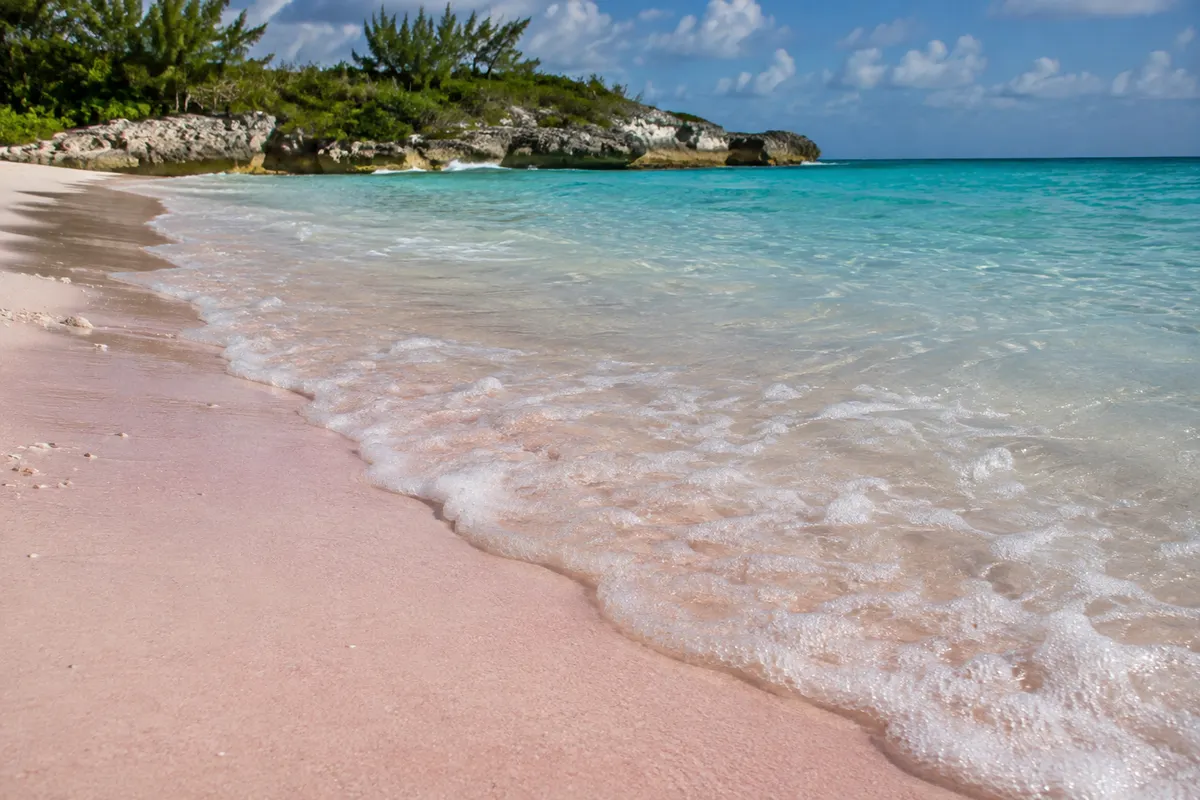
Walk along the Atlantic beach on Harbour Island and the sand may seem almost white in the bright noon sun. In a different light, particularly close to the damp waterline, a delicate pink shade becomes visible. The effect is not a uniform layer of pink material but a mixture of differently coloured grains.
What gives the sand its colour?
Much Bahamian beach sand consists of carbonate particles derived from marine organisms and rock. Tiny organisms called foraminifera contribute reddish fragments to some beaches. These fragments mix with white and cream-coloured grains of coral, shell and other carbonate material. The resulting colour is quite variable, even along the length of a single beach. Bright promotional photographs may exaggerate the saturation considerably.
Waves and currents break down, transport and sort sand. A stretch of beach may look different after a storm or during a very different tidal state. Try looking closely at a handful of loose sand without taking it home. You can often distinguish the darker grains among the paler ones.
Where to look
Pink Sands Beach on Harbour Island is the best-known example. Parts of Eleuthera and several other Bahamian islands also have sands with a pinkish tone. Conditions on ocean-facing beaches change with the wind and swell. A calm-looking area is not necessarily safe for swimming. Consult local advice, particularly when visiting a beach without a lifeguard.
Visiting with a little patience
Walk in the cooler morning or later afternoon, when shadows make the texture of the sand easier to see. Respect dune vegetation and use established access paths. The small grasses and shrubs along the dunes are important for the stability of the shoreline; trampling them for a photograph damages the very beach you came to enjoy. Take photographs rather than bags of sand, and remember that an ordinary quiet morning here can be more memorable than any particular hue.
Looking closely at the grains
The faint pink shade is often easier to distinguish when the grains are wet, although the precise colour depends on light and the material at that point on the beach. Near the dry upper shore, wind may have sorted the grains differently. Try comparing these areas visually as you walk. Photographs can vary dramatically with camera settings, so it is unlikely that one picture will capture exactly how the beach appeared to you. There is no need to remove sediment or living organisms to appreciate the details. Even shell fragments tell part of the story of material moving between the sea and land.
A closer look at foraminifera
The organism principally associated with these beaches is easy to overlook on a typical reef trip. Foraminifera are not pieces of coral and they are not insects, although older descriptions have sometimes referred to them rather loosely as coral insects. They are single-celled organisms, many species of which form a tiny external shell known as a test. These shells may have several chambers and are commonly built from calcium carbonate. Some species live upon the seabed, rocks and vegetation, while others float in the water.
One of the foraminifera particularly associated with pink sand in the tropical western Atlantic is Homotrema rubrum. A geological study of Bahamian limestone identifies the characteristic pink fragments of this encrusting organism. As its tests break apart naturally, small pieces may ultimately be included in sediments. A considerable accumulation of marine material over time, together with suitable coastal conditions, can tint a pale stretch of sand.
The other ingredients of a Bahamian beach
Imagine the upper layers of a beach as a collection of particles from different sources. There may be rounded fragments of limestone, broken pieces of mollusc shell, material from calcareous algae and remnants of coral skeletons. Some carbonate grains also form as minerals accumulate in layers around existing particles in shallow, warm seawater. The development of these particles and their eventual movement to the coast help explain the exceptional pale colour of Bahamian sand.
Marine animals contribute to this process in less obvious ways. Parrotfish scrape food from hard reef surfaces, swallowing some calcium carbonate as they feed. Their digestive systems process the organic material and the remaining mineral particles may be released as sand. This is just one of several ways in which reef animals produce or redistribute sediment. NOAA's explanation of how sand forms describes the contrast between beaches made largely from eroded continental rock and those where the activities of marine organisms play a greater role.
The main ingredient in many beaches elsewhere in the world is quartz, which survives long journeys down river systems from inland rocks. On a low Bahamian island, there are no large rivers carrying this kind of inland sand. Coral reefs and other marine and limestone carbonate sources therefore play an unusually important part in the local shoreline.
Why the pink appears in one place but not another
The answer is partly a question of proportions. A few coloured grains among a very large number of white ones will barely be noticed. When enough reddish material is caught in the shore sediments, the collective effect becomes visible across a patch of beach. Currents and waves may move fine grains differently from larger fragments, gradually sorting and redistributing the mixture.
The shape of the coast also influences where material survives. An exposed part of the ocean shore may experience a different pattern of movement from a protected cove. During a storm, sand may be transported offshore or carried farther up the beach. Subsequent calmer conditions may return some of that sand to a different part of the coast. The particles visible in a photograph are consequently only a small moment in a very long natural process.
Two islands for discovering blush-coloured beaches
Harbour Island is the obvious starting point, particularly if you intend to spend much of a holiday walking beside the Atlantic. Pink Sands Beach runs for several miles along the eastern shore, so visitors staying around Dunmore Town on the harbour side need to cross the narrow island to reach it. The official Pink Sand Beach guide describes both the beach and the origin of its colour.
There are also stretches of pinkish sand on mainland Eleuthera. One that is convenient to include during a stay near Governor's Harbour is French Leave Beach, along the eastern stretch of Bank's Road. This long Atlantic strand was formerly associated with a Club Med resort, which accounts for a name you may still hear when asking for directions.
The differences between the two islands can affect the way you organise your holiday. Harbour Island is comparatively small, with much of the movement between accommodation, beaches and town taking place over short distances. Eleuthera is long and narrow, and you may need a car to reach several beaches comfortably. Choose a base first, and check the conditions and access routes to the particular beaches you wish to visit. Neither island needs to be crossed end to end in a day just to compare the colour of the sand.
What a living shoreline needs
The attractive photographs of pink sand in the Bahamas are also photographs of a dynamic marine environment. Offshore reefs help modify the energy of incoming waves and contribute particles to the sediment. On the shore, natural dune systems trap sand that might otherwise be carried away by the wind. The layers of vegetation above the high-water mark help maintain this system, which is why it is important to use established paths rather than clearing a shortcut across the dunes.
On a reef outing, make sure equipment and fins do not touch coral or other living organisms. If you have an interest in the geological details of a beach, photographs showing grains up close are more appropriate than collecting samples to take out of the country. Local restrictions may apply to removing natural material, and the individual coloured particles are part of a much larger shoreline that depends upon their continued movement and accumulation.
Pink sand illustrates the intricate connections between small marine organisms, the movement of their remains and the geology of the islands.