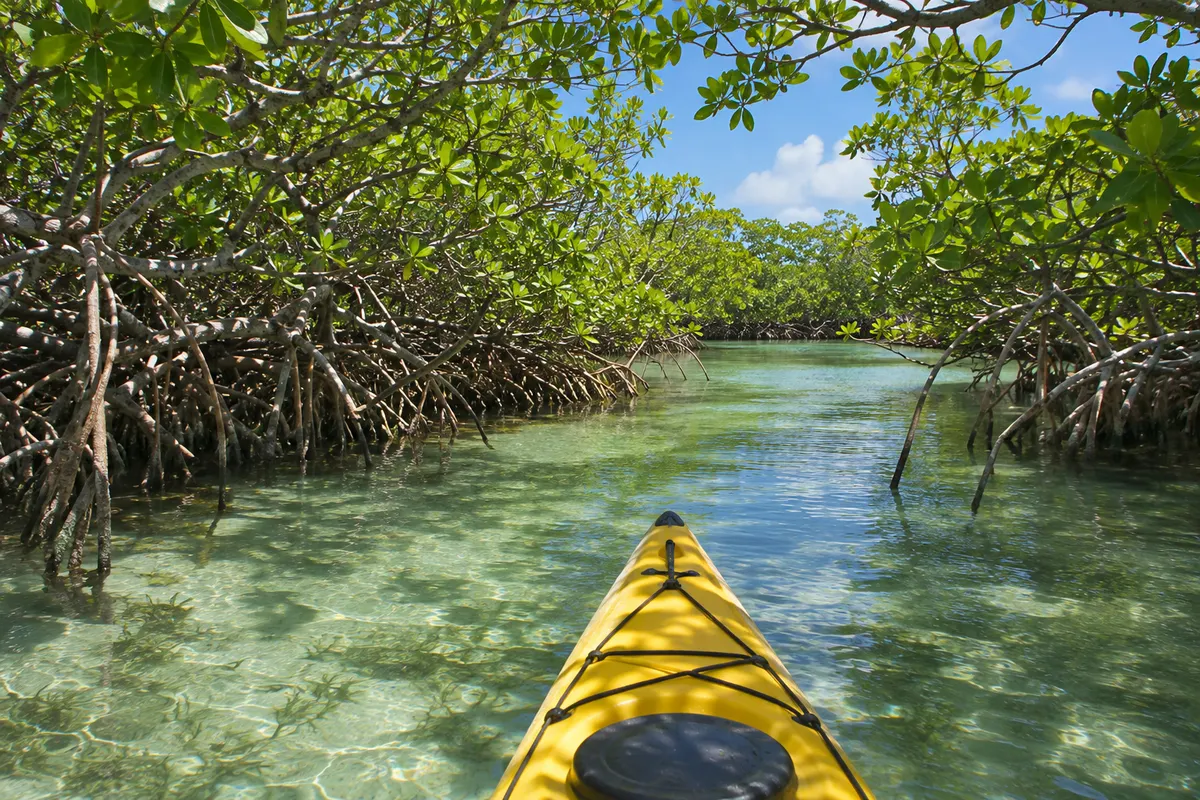
At first glance the fringe of tangled trees along a Bahamian creek may appear to be little more than an obstacle between a boat and the shore. Look into the water between the roots and the purpose of the habitat becomes clearer. Young fish move through narrow spaces, crabs cling to branches and the roots intercept sediment carried by the tide.
Trees that live beside salt water
Mangroves are adapted to places where ordinary woodland trees cannot grow easily. In the Bahamas, red mangroves are especially recognisable by their arching prop roots. Other mangrove species occupy slightly different positions in the intertidal landscape. Together they contribute to the stability of shallow coastal areas and provide shelter and feeding grounds for marine life.
Large mangrove systems can be found on Andros, in parts of Grand Bahama and around sheltered waterways throughout the archipelago. Differences in tidal exchange and water depth determine the plants and animals found in any particular creek.
Exploring quietly by kayak
A kayak or paddleboard can be a pleasant way to look at a shallow creek, provided that conditions and access are suitable. Choose an established route or a guided visit, especially if you are not familiar with tidal channels. A creek that is easy to enter at high water may be difficult to leave later. Local guides can point out birds and marine life without disturbing them.
Avoid dragging a craft across seagrass or through exposed roots. Keep away from nesting birds and do not chase turtles or fish. A motorboat should use suitable channels rather than cutting over sensitive shallows.
Why this shoreline matters
Mangrove forests provide protection against some coastal erosion and storm effects. They also connect habitats that are often discussed separately: shallow seagrass areas, open water and inland wetlands. For a visitor interested in more than beaches, an hour spent looking carefully into a mangrove creek offers a different understanding of the Bahamas. Bring a sense of curiosity, binoculars if you have them, and leave the habitat as you found it.
The creatures along the roots
In clear shallow water, stand quietly on an authorised boardwalk or look from a stable kayak. A small movement between the roots might reveal a juvenile fish or a crab. Birds watch the same shallows from overhanging branches, waiting for an opportunity to feed. Avoid using bait to attract animals for a photograph. The finest part of watching these habitats is seeing how creatures use them naturally. Mangrove stands can be very different in height and density according to the conditions in which they grow, and their sheltered waters are closely connected with the neighbouring seagrass beds.
How a mangrove survives its awkward surroundings
At the edge of a tidal forest, the soil receives salt water and stays saturated for periods of the day. A tree adapted to ordinary garden soil would struggle to grow here. Mangrove trees cope with these conditions in several ways. Some have roots that exclude much of the salt from the water they take up, while others can get rid of excess salt through their leaves. There are also structures that allow parts of the root system to obtain oxygen even when the muddy ground underneath contains very little.
The red mangrove's exposed supports are particularly easy to recognise. Look farther away from a creek and you may notice black mangroves, with ascending root structures that poke up from the sediment. These stand among the leaves like short dark pencils. Many trees also produce distinctive propagules that begin developing while still attached to the parent before dispersing in water. The NOAA explanation of mangrove forests offers a useful introduction to the habitat and its unusual adaptation to the rhythm of the tide.
Bonefish Pond on New Providence
Visitors staying around Nassau do not have to cross the islands in search of their first tidal forest. Bonefish Pond National Park protects a surviving wetland on the southern coast of New Providence. The boardwalk gives people a view into a sensitive area without needing to travel through the water. It is a distinctly different outing from the busy harbour area or a day on an open beach. Its sheltered channels can feel particularly quiet, with calls of birds occasionally breaking the stillness.
The park is also a place for environmental education. The name reflects one of the kinds of fish that visit the shallows. Depending on the time of day and the conditions, you might instead see small schools of other fish or birds searching for food near the water. Neither wildlife nor particular activities can be guaranteed on a given visit. Check the park's current admission arrangements and whether a guided visit is available before setting out. A morning here is a useful introduction to the kinds of coastal habitat found close to more remote Bahamian islands.
From Grand Bahama's creeks to the Andros wilderness
Gold Rock Creek in Lucayan National Park on Grand Bahama illustrates the close proximity of the islands' different natural environments. Visitors can approach the mangroves as part of a wider look at caves, trees and the coast facing the open sea. The creek is important for marine organisms that find shelter in its protected waters. It is also a vivid example of how a change in terrain over a short distance leads to a change in the wildlife occupying it.
Western Andros is on an entirely different scale. Much of the shoreline in West Side National Park remains relatively wild and difficult to reach. Long stretches of shallow water and broad coastal wetlands give way to winding creeks. The park is accessible by boat and has little visitor infrastructure. An outing arranged by a specialist guide is a very different proposition from a short walk in an urban area. For a visitor with limited time or limited mobility, a more accessible wetland may offer a better chance of appreciating the landscape.
Where mangroves meet coral reefs
The edge of a mangrove creek is not a barrier marking the end of the habitat's benefit to the sea. Fish that shelter near the roots as juveniles may later range out across seagrass beds or farther offshore. Some move between environments during the course of a day, while others change habitats as they grow. The connection helps explain why areas of protected forest and healthy coastal vegetation contribute to fish communities in the waters around them.
Seagrass is particularly important in this network of habitats. Its blades slow the current and make shelter for small animals over a much broader stretch of shallow seabed than a narrow mangrove fringe would provide. A visitor travelling from a jetty out to a coral reef may cross the entire sequence in a few minutes. The water's appearance changes from sheltered dark reflections to patches of green and finally to pale blues. The visual experience is also an introduction to a system in which seemingly separate natural areas support one another.
An important part of recovering after storms
Although mangrove forests can help reduce damage from moving water, very powerful hurricanes also affect the trees themselves. Branches break, sediment moves and salt water may remain in places for longer than the plants can tolerate. Recovery is influenced by conditions both at the site and in the surrounding landscape. In areas where creeks have been filled or altered, re-establishing a natural exchange of water is often as important as replacing individual trees.
Conservation organisations and Bahamian communities have been involved in wetland restoration on islands affected by storms, including Grand Bahama and Abaco. The work involves studying the places where mangroves survive and understanding how sites damaged by severe weather can recover. Travellers who want to support such efforts can learn about local conservation programmes, visit responsibly managed parks and use locally operated guiding services. Do not move seedlings or try to plant them in an unfamiliar area on your own initiative. A modest boardwalk visit can leave both the visitor and the habitat better off: the forest provides a window into life beside the sea, while careful observation leaves its delicate processes intact.