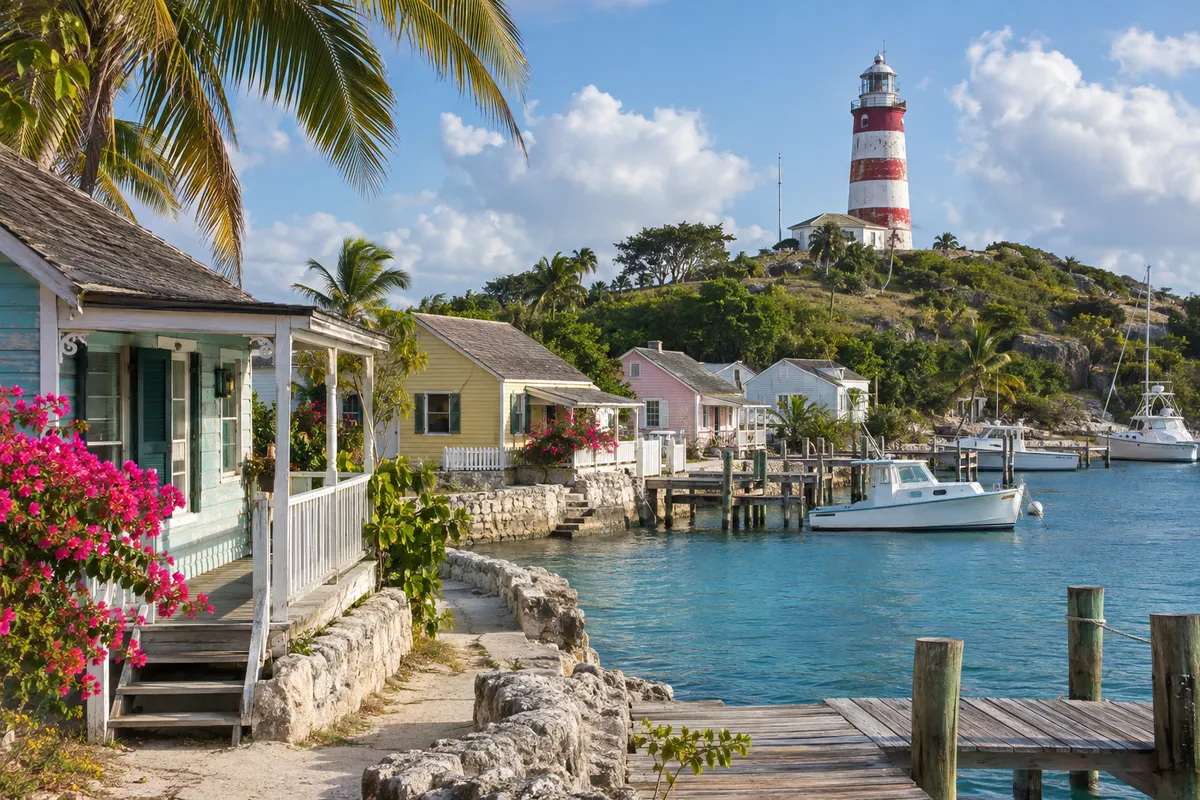
Reefs and shallow banks are part of the beauty of the Bahamas, but they were also a serious hazard for ships moving through the region. For generations, mariners approaching the islands depended on landmarks, local knowledge and navigational lights. The remaining historic lighthouses belong to that maritime history.
Elbow Reef Lighthouse
Hope Town on Elbow Cay has one of the most recognisable lights in the country. The red-and-white tower overlooks the harbour, and its distinctive appearance is visible from boats approaching the settlement. The lighthouse is celebrated for its traditional equipment and the work of its keepers. When visiting, check whether the tower is open and which paths or stairs may be used. Working navigational equipment and restricted areas must be respected.
From the surrounding grounds, visitors can appreciate the relationship between the harbour, the reef and the entrances used by boats. An apparently short distance over water can contain shallows or hazards that are difficult to recognise from deck level. A boat trip with a knowledgeable local operator makes the geography easier to understand.
Lights elsewhere in the Bahamas
Lighthouses and smaller navigational markers can be found around the archipelago. Some stand at exposed points or on islands with no convenient road access. Their construction often reflected the materials and resources available at the time, and maintaining them in salt air and storm conditions was demanding. Not every historic tower is accessible or safe to enter. Find out its status before planning a visit.
A maritime perspective
The history of the islands includes wrecking, fishing, trade and the long work of people who guided ships through dangerous passages. A lighthouse provides a striking physical reminder of that history. Look beyond the paintwork at where the tower was placed and what a mariner would have seen approaching it. In Hope Town, a walk through the old settlement and some time beside the harbour completes that perspective without requiring a busy sightseeing schedule.
The view from the sea
A lighthouse was designed to be recognised by a mariner approaching from a distance. Its position, colour and light had to distinguish it from other landmarks. Look at the shoreline below a tower before thinking about the view from its top. A reef may be visible as a change in colour or a band of breaking water far from the land. In daytime these natural details are easier to see than they would have been at night. Historic lights speak of the need to make a passage safe long before modern navigation instruments were available.
A collection of landmarks built for shipping
Much of the lighthouse history of the Bahamas can be viewed as a single maritime project. Between the 1830s and late 1880s, the British Imperial Lighthouse Service commissioned a series of lightstations for dangerous approaches and sections of the archipelago passed by international shipping. The first consideration in selecting a site was not convenience for visitors but the usefulness of a light to vessels at sea. A hill could make the lamp visible above intervening land, while low reef islands required taller structures to put the light at a comparable elevation. There were also less obvious requirements: it had to be possible to deliver fuel and food, build accommodation for the keepers and carry out repairs when the weather permitted. A lighthouse on a remote cay was quite different from one standing near a well-established town. Together with other coastal markers, the towers formed a system in which each point had a purpose. A mariner passing through the region might be able to identify one light after another on a long journey without stopping ashore.
How the lamp and the lens worked together
A lighthouse might appear from the ground to have an enormous lantern set in a glass room. Its optical equipment is more interesting than that simple description suggests. A Fresnel lens consists of carefully shaped glass sections able to collect light and direct it into a relatively narrow beam. An ordinary lamp spreads its light in many directions; concentrating a greater share towards the horizon allows the signal to be seen from much farther away. In a revolving arrangement, the way the lens passes a viewer determines the sequence of flashes. Different lightstations have identifiable light characteristics that distinguish one from another in the darkness. Inside the lantern room, it is also important to keep the glass and associated machinery clean and in good working condition. Small changes in the position or state of the equipment might reduce its usefulness. This was one reason why traditional lighthouse work demanded considerable attention from the resident keepers, and why a preserved optical apparatus is so valuable to anyone interested in the history of maritime engineering.
A working light on Elbow Cay
The Elbow Reef Lighthouse dates to 1864 and rises about 89 feet from its base to the top of the tower. The lantern contains a large revolving Fresnel lens and its distinctive light has historically been recognised by a repeated group of five flashes. It is particularly interesting because so much of the traditional equipment remains in operation. The volunteer Elbow Reef Lighthouse Society explains the lightstation's history, including the efforts made to preserve it when automation of Bahamian lighthouses was being considered. Maintaining a working heritage site implies quite a different responsibility from managing a museum that exhibits retired machinery. Someone has to ensure the light can perform its maritime role while the grounds and buildings are kept in good condition. The attraction therefore extends beyond the tower and its famous bands of colour. It is a little community of service buildings, pathways, places to live and carefully maintained pieces of equipment. Descending the stairs after a visit, one can appreciate how much effort was required simply to carry supplies up to the lantern room.
Dixon Hill and the southern islands
Some of the archipelago's other lightstations occupy dramatically different landscapes. On San Salvador, Dixon Hill Lighthouse stands on high ground above sections of the island that were once occupied by plantations. Completed in 1887, it is relatively accessible compared with lights on uninhabited reef cays. Visitors approaching it by land see an interior of scrubby limestone country, an environment that may not look particularly maritime until they reach a viewpoint and see the ocean below. See the official tourism office's Dixon Hill Lighthouse page for background and local contact information, and ask which parts are open to the public. In other parts of the Bahamas, small markers stand in areas reached only by crossing stretches of open or shallow water. Great Isaac Cay, at the northern extremity of the Bimini chain, is a well-known historic station of that kind. The spectacular appearance of a tower offshore is not by itself a reason to attempt a landing. Conditions, access permissions and the experience of the captain must be considered first.
Keeping maritime heritage in the islands
Over time many of the original lamps and mechanisms were adapted, dismantled or replaced by automatically operating lights. Electric lamps supported by batteries and solar panels reduced the need for complicated fuel-burning machinery and regular visits to the lantern room. This is practical for keeping navigational aids operating but means that rare examples of the older engineering are easily lost. The cultural value of Bahamian lightstations is recognised in the series of historic lighthouses entered on the country's UNESCO World Heritage Tentative List. This is not the same as inscription as a World Heritage Site. The proposal is interesting because it considers the network of towers and surviving buildings together, rather than the architecture of just one landmark. Each presents questions of restoration: which painted finishes belong to the original construction, which reflect later changes, and what can still be used safely? Local historical organisations and keepers know a great deal about the answers, and visitors can support their work by respecting access restrictions and any requests for contributions.